In honor of Breast Cancer Awareness month, here’s my story about how my breast cancer was found.
After my divorce was finalized in June 2025, I had to find my own health insurance. I was able to secure it quickly through the Virginia Healthcare Marketplace and it went into effect in July 2025.
Later that month, I went to Montana for a couple weeks. When I returned, I got into the business of finding all new healthcare providers—I had moved from Annapolis to Alexandria when the lease on the place I shared with my ex ran up in April 2025.
The first doc I wanted to secure was a gynecologist—and I wanted someone who specialized in perimenopause and took such concerns seriously. I consulted many a website and a local military spouse facebook group I was a part of and never left. I got a name, called her office, and scheduled an appointment for October 1, 2025.
She was incredible. At our appointment we did the usual check-up, I shared my perimenopause concerns with her, she prescribed me an estradiol patch and progesterone to take at night, and wrote the referral for my annual mammogram.
I called the Fairfax Radiology office that day and scheduled my mammogram for Monday, November 10th. (I also started the hormones and they were awesome.) Between October 1st and November 10th I pulled all my past mammogram results—four years worth, each from a different radiology office due to my many moves—and put them in the appropriate online portal. I had never missed a mammogram since my first one, which was done when I turned 40.
I went in for my annual mammogram on November 10th, with no symptoms. In and out, just like always.
On November 12th I got word the mammogram found “left breast calcifications and asymmetry for which further evaluation is recommended.” Further evaluation was another mammogram with possible ultrasound. I was 0% worried as I had done a mammogram with an ultrasound the very first time I had a mammogram. I have dense breast tissue. This was my first time with Fairfax Radiology. I assumed they were just being safe.
This appointment was scheduled for Monday, November 24th. It’s in my calendar as “Mammogram 2.0 / Possible US.”
I went to the appointment and was taken back for a mammogram of my left breast. Afterwards, I was escorted to a different waiting room. Much smaller and nicer than the first. Squishier chairs. Warmer lighting. A lamp. I remember thinking, “If this shit comes back positive I’m going to do [X] and [Y].” While I was waiting, they had a radiologist look at the mammogram and decide right away if I needed an ultrasound or not.
I did.
I was escorted back into the room and an ultrasound was done. Much more pleasant than a mammogram. Once the ultrasound was complete, the images went straight back to the radiologist.
The radiologist came into the room and told me he saw calcifications in two separate areas of my left breast (one a little more concerning than the other), and asymmetry. He recommended I get a biopsy—”though usually the biopsies come back with nothing,” he said. I got dressed and was escorted to an office where a woman sat behind a large desk. It was an even nicer space than the small waiting room.
She told me what a mammogram-guided biopsy would entail: I’d lie face down on a table with my left boob hanging through an opening, where it would be compressed—a mammogram, but lying down. They’d numb my breast, use a needle to remove part of the suspicious tissue, and leave behind a tiny clip marking the spot in case I needed surgery. The tissue would be sent to pathology.
For someone who hates needles, none of this sounded fun. But whatever. It had to get done.
After the biopsy, I had to wear a sports bra 24/7 for five days, ice my breast on and off for a full day, and, for a week, not lift anything heavier than five pounds or submerge myself in water.
For someone who had recently upped her weight-lifting game, started cold plunging, and loves baths, this sounded like my personal idea of hell. And sleeping in a sports bra?! You’ve got to be kidding me.
That mammogram-guided biopsy was scheduled for Monday, December 8th. I went, I did the things, the clip was found to be in the right place, I iced, I wore the sports bra, I walked instead of lifting, and just suffered without my sauna and cold plunge.
On Monday, December 15th (364 days after my husband told me he wanted a divorce) I received a call from Fairfax Radiology. It went to voicemail. I was working at the retail store I worked at super part-time. I saw the voicemail after my shift and thought, they never call. But I had never worked with Fairfax Radiology, I thought, so maybe this is just their protocol.
I started to walk to the gym. I had packed my workout clothes so I could go there after my shift. I decided to call them back when I reached the block where I’d turn right to go to the gym or keep going straight to walk home, depending.
I called. I turned toward the gym and kept walking. As I made my way down the north side of Madison Street, between St. Asaph and Pitt in Old Town Alexandria, VA, Angela from Fairfax Radiology told me my biopsy had come back positive for breast cancer.
DCIS. Stage zero.
Angela started to tell me what was next. I asked her, as I stopped walking, if I could call her back when I had a pen. I wasn’t home. I needed to take notes. I hung up, turned around, and walked home. There was no one to hug me when I walked in the door. I found a pen. A notebook. (I have different notebooks for different purposes. I did not have a notebook for this purpose.) I called Angela back.
She told me I’d be getting a call within the next 24 hours from a nurse care manager who works for a breast surgeon they had already called about my case. The nurse care manager would tell me the next steps. I remember hoping that the surgeon they referred me to was good. This was kind of a big deal.
I got the call within two hours. The nurse care manager was named Cami.
Cami told me because there was another area of concern in my left breast, they wanted me to have a mammogram-guided biopsy done on that area too. She scheduled that appointment for that Friday—December 19th. She scheduled me for a consult with the breast surgeon on Thursday—December 18th. She scheduled me for an MRI—a standard “next-level up” screening once breast cancer is diagnosed—for early the morning of the 18th, before my consult. She scheduled me for genetic testing on Wednesday—December 17th.
We were not messing around.
I got off the phone with Cami and called my family. My brother had stayed with me after Thanksgiving and had just driven to Richmond to visit friends. He was with me when I had the first biopsy. He laughed about the room upgrades, and teased me about icing my boob, and was around to lift things that were more than 5lbs—and walk my dog. Something else I was advised not to do as I healed. He drove back up right after I called him. My mom scheduled a flight and she would be there the next day.
I pulled the “family history of cancer” details from both of my parents. My half-aunt had DCIS. My grandmother had colon cancer—stage one, caught super early, surgically removed in a colonoscopy. A few others had cancer here and there, much later in life.
I did the genetic testing questionnaire and interview on Wednesday, as scheduled, and the blood work for it on Thursday, December 18th. The genetic testing came back negative—not just for the BRCA genes, but for all cancers they can genetically test.
While I was in the consult with the breast surgeon that same Thursday, she received a call from the radiologist who was looking at the results from the MRI I had completed less than an hour before. The results had been rushed. He said there was another area of concern. About 5mm. In the left breast.
She got off the phone. “We need to do an MRI-guided biopsy,” she said. It had to be MRI-guided as that was the only test that showed this particular area of concern.
This biopsy would be similar to the others, except they’d use the MRI to guide the needle into the suspicious area. (Which, fun fact, involves having a biopsy needle stuck in your breast while they slide you back into the MRI machine to take an image before sliding you back out and doing the biopsy. It’s a lot of needle time.)
The next available appointment was more than a month away: Thursday, January 22nd.
It seemed like an endless time to wait.
It turns out, there was something else that needed to get checked out in that time frame.
The other cancer.
Which we didn’t know was cancer yet.
My surgeon explained what DCIS was. So had Google, which I’d done a lot of that first night, but I let her tell me all the things.
DCIS stands for Ductal Carcinoma In Situ. This means cancerous cells had been found inside the milk ducts of my left breast but had not extended beyond them. They were contained.
Therefore, stage zero.
My DCIS was also ER+, PR+, and HER2-. Pathologists figure this out by testing the tissue pulled from the biopsy. ER+ and PR+ meant the cancer cells had receptors for estrogen and progesterone, so those hormones could fuel their growth.
HER2 is a protein involved in cell growth. HER2-positive breast cancers have too much of it, which can make them grow more aggressively.
Mine was HER2-negative.
A win.
I was encouraged to immediately stop the estradiol and progesterone I’d started six weeks earlier. I was assured those hormones had not caused the cancer—I hadn’t been taking them nearly long enough—but I was still super bummed to lose them. I had already noticed improvement in my mood, sleep, and energy.
Treatment would mean surgery, likely radiation if I chose a lumpectomy, and endocrine therapy. Since I’m premenopausal, my endocrine therapy would be Tamoxifen—a drug that blocks estrogen from fueling hormone-sensitive breast cancer. So not only had I lost my estradiol patch, now I was looking at five years of medication designed to keep estrogen from feeding any remaining cancer cells.
Medical-induced menopause. With all the symptoms, and dangers, of regular menopause.
The surgeon gave me the name of a plastic surgeon she recommended. The plastic surgeon is who I would consult about whether I wanted a lumpectomy, a single mastectomy, a double mastectomy, or a breast lift on the other side—all of which would be covered by insurance. The surgeon was just responsible for removing the cancer and getting good margins, not reconstructing anything. They’d work together in surgery—surgeon cuts out cancer, plastic surgeon puts me back together.
I did the second mammogram-guided biopsy, as scheduled, the next day.
It also came back positive for DCIS: ER+, PR+, HER2-.
I got this call while at the gym. I answered while stretching. She sounded really upset. I told her it was fine, I already had DCIS. My trainer told me I wasn’t allowed to use the phone on the floor. When I was done with my workout I apologized and told him I have breast cancer.
Now that I had two areas of DCIS, I was concerned about how much tissue would have to be removed from my breast. There were two cancerous areas, plus the third suspicious spot on the MRI.
I did not want a mastectomy.
I did not want to lose a breast.
(That’s a whole other story for a whole other time.)
Also, the clip from this second biopsy had moved when they decompressed my breast. This meant if I chose to have a lumpectomy, I’d have to have another clip placed.
More needles.
Big ones.
Just over a month later, on Thursday, January 22nd, I did the MRI-guided biopsy as scheduled.
Cami called me the following Tuesday.
The tiny—5mm—area they had found on the MRI was also cancer.
But it wasn’t DCIS.
It was IDC: invasive ductal carcinoma, the most common type of breast cancer (about ⅔ of all cases).
Invasive.
This one had escaped the ducts.
Its biomarkers were different, too: ER+, PR- and this time, HER2+. Fifteen percent of breast cancers are HER2+. Of those, 50% are also hormone positive. I fall in that 7.5%. Always an A student.
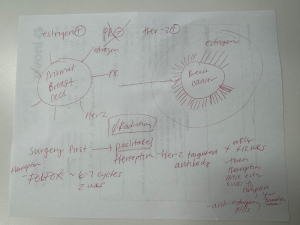
“HER2+ breast cancer is not as dangerous as it used to be,” Cami reassured me. There’s now a drug that’s used to specifically target HER2—Herceptin.
Suddenly, we weren’t just talking about surgery, radiation, and hormone blockers anymore.
We were talking about chemotherapy.
And a year of Herceptin infusions every three weeks.
What had started as stage-zero breast cancer was no longer just stage zero.
So, to recap, here was the path from routine mammogram to invasive breast cancer diagnosis:
Oct 1: Mammogram referral given
Nov 10: Annual mammogram done
Nov 24: Mammogram + ultrasound one done
Dec 8: Mammogram-guided biopsy one done
Dec 15: Positive for DCIS, ER+, PR+, HER2-
Dec 17: Genetic testing done
Dec 18: MRI done
Dec 19: Mammogram-guided biopsy number two, done
Dec 22: Positive for DCIS, ER+, PR+, HER2-
Jan 22: MRI biopsy done
Jan 27: Positive for IDC, ER+, PR-, HER2+
“You’re a mammogram success story,” my surgeon said during our appointment on January 29, when the surgical plan was put in place.
Earlier in that appointment, I had decided to have single mastectomy. There were three cancerous areas in my left breast. Too much tissue would have to be removed. I’d barely have a breast remaining.
I didn’t have time to heal from a double mastectomy.
Because by then, we also knew I had another cancer.
Stage three rectal cancer. Advanced.
I was being rushed into surgery. I would have the single mastectomy on Monday, February 9th.
“But we didn’t find the invasive breast cancer on a mammogram,” I said. “Or the ultrasound.”
“Yes,” she said. “But you wouldn’t be here if it wasn’t for that mammogram.”
I understood.
When we got the news about the first DCIS, my mom had said something similar.
“I’m so glad you got your mammogram. Many people in your situation—recently divorced—just wouldn’t.”
I remember not understanding what she meant.
Why wouldn’t I?
My life had blown apart. My marriage was over. I had moved. I had new insurance. I needed new doctors.
But my mammogram was due.
So I got my mammogram.
It didn’t find the invasive cancer.
But it started the chain of events that did.
–
This will be my first October as a breast cancer “survivor,” whatever that means. (The National Cancer Institute uses the word *survivor* from the time of diagnosis, which is why I use it here.)
It will be very pink.
There will be ribbons. There will be slogans. There will be the sexualization of a disease that is not particularly sexy. There will be companies selling pink products without meaningfully supporting people with breast cancer. “Pinkwashing,” as I’m learning it’s all called.
As a former marketer, I have complicated feelings about all of that.
But I don’t have complicated feelings about this:
Breast cancer is the leading cause of cancer death among women under 50 in the United States.
I was 44 when I got my diagnosis.
So.
Please get your mammogram.
And please encourage the people you love to get theirs.
On Friday, October 2, 2026, I’ll have my first mammogram “since.” Surveillance.
This one—and all of mine for the next several years of my “surveillance era”—will come with an ultrasound. I’ll have them every six months. And I’ve already made my request to add breast MRIs to the mix, too.
So I’ll keep getting mine.
Please get yours.
You’re worth it.
If you’d like to share this post on social media or via email, please do so. (And thank you!) You can copy and paste this direct link: https://lumpsandhumps.com/faq-how-did-they-find-your-breast-cancer/
To listen to an audio version of this on Spotify, click here. To listen on Apple Podcasts, click here.
To get posts sent directly to your inbox, click “Subscribe” at the top of the page.


6 Comments
Hi Allie, You’re a great writer! Every post we read, Leslie and I talk about how compelling it is and how unflinching. You’ve alluded to your work recently. What’s your current job?
Thank you so much, Steve. I’m super touched that you and Leslie have subscribed and read it all! Short answer – I don’t have a job. I’ve not been able to work since all of this started. Medium answer – before this, I was working as a yoga and meditation specialist and assistant instructor for a company called O2X Human Performance. Before that, I was trained as a trauma-informed yoga therapist specializing in work with trauma and the military. The work was totally freelance and very sporadic. Really long answer will be in the book. 😉 We’ll see what I do when all of this is over!
OKAY. I’ve been ignoring my reminders for about 3 weeks so I will call today to schedule. Thank you for the push.
Yes! Go, Shelley!
Upped my annual November Mammo to one with ultrasound — which I did for many years after a scare that went pretty much exactly like yours with different results (the dense tissue, area of suspicion, biopsy, clip etc.). After 10 years no more ultrasounds except this year and because of you ! I’m doing the ultrasounds again. 💕
Your writing as usual is phenomenal. You keep going, Alli, this world needs more women like you.